What's going on in Mr. Solarz' Class?
  • Parent (Current Newsletter)
    • Additional Parent Resources >
      • Homework Guidance for Parents
      • WEX - Writer's Express
      • Our Classroom YouTube Page
      • Should I grade homework?
      • Articles that Explain my Philosophy of Teaching
      • Parents Supporting 21st Century Learning
    • Daily Photo Journal >
      • 2014-2015 DaIly Photo Journal
      • 2013-2014 Daily Photo Journal
      • 2012-2013 Daily Photo Journal
    • Tentative Schedule this Week
    • Parent-Teacher Conference Schedule
    • Monitoring Your Child's Progress in Spelling
    • Calendar
    • Printables
    • 21st Century Skills
    • Westgate Social Work
    • Bessie's Table Soup Kitchen
  • Students
    • Overflow Roll-Out >
      • Contests You Can Enter!
      • Student Quotes
      • Websites to Visit for Homework!
      • REARJMCL
    • Calendar
    • Mini-Lessons
    • I Never Knew That!
    • History Alive! >
      • Sign-In Page
      • Online Tutorial
      • History Alive 10 Quiz
    • Spelling
  • Educators
    • Mr. Solarz' ePortfolio >
      • Teacher Evaluation
      • Domain3
      • Domain4
      • My Digital Scrapbook
      • Finland
    • Workshops I've Led >
      • How to Set Up and Run a Mystery Skype Session
      • Creating Your 21st Century Classroom
      • Twitter for Educators
      • Leading Children to Pursue their Passions
      • Becoming a Global Classroom Through Mystery Skypes
      • Enriched Learning Projects
      • Developing Units with 21st Century Skills in Mind
      • Who Owns the Learning? Examples of 5th Graders Running the Show
      • A Brief Introduction to China (for 2nd Graders)
    • 21st Century Learning >
      • Resources for Teachers >
        • 21st Century Skills
        • The 21st Century Skill Series of Videos
      • Examples of 21st Century Education in Action >
        • Self-Directed Students
      • 21st Century Assessment
      • Web 2.0 Tools Used in Our Classroom
      • Articles for 21st Century Teaching (Updated Daily)
      • Motivational Speakers
    • Curricular Units >
      • Social Studies Units >
        • The 2012 Presidential Election
        • The Revolutionary War
        • U.S. Constitution and Government
        • Westward Movement
      • Science Units >
        • Energy
        • Science Fair
        • Human Body Systems in Motion
        • Human Body Systems in Motion
        • Watery Earth
    • EdChat Archives >
      • #TLAP
      • #5thchat
      • #21stedchat
    • My Philosophy of Education
    • Tips and Tricks for the Elementary Classroom
    • China (Photos)
  • Past
    • 2013-2014 >
      • Year-Long Activities >
        • Passion Time >
          • Passion Projects >
            • 2013-2014 Passion Projects >
              • Passion Projects 10/11/13
              • Passion Projects 11/22/13
              • Passion Projects 12/20/13
              • Passion Projects 2/12/14
              • Passion Projects 3/21/14
              • Passion Projects 5/2/14
              • Passion Projects 6/2/14
            • 2012-2013 Passion Projects >
              • Passion Projects 1
              • Passion Projects 2
          • Guidelines for Creating Your Final Product
        • New Assignments
        • Mystery Skype
        • Literature Circles >
          • Discussions & Signposts
          • Book Talks >
            • Submit Your YouTube URL Here
      • Spring Trimester >
        • Our Learning Experiences
        • Westward Expansion >
          • Oregon Trail Pastimes
          • VoiceThread Blog
          • Pinterest
          • VoiceThread
          • Timeline
          • Diigo
          • Google Presentation
          • Photo Stories
          • Tableaux Vivants
          • Daily Travel Log
          • Fictional Travel Log
          • Video Journal
        • WEX - Fictional Narratives
        • 21st Century Skills
        • Motivational Posters
        • Watery Earth >
          • Bodies of Water
        • Colonize Mars! >
          • Claiming Mars For Ourselves
      • Winter Trimester >
        • 100 Word Challenge
        • Stations
        • Human Body Unit
        • Out Of My Mind
      • Fall Trimester >
        • Historical Reenactment
        • Tessellations
    • 2012-2013 >
      • April/May/June >
        • Mystery Skype
        • Colonize Mars!
        • Science Fair 2013
      • February/March >
        • ThingLink
        • Human Body
        • Revolutionary War Simulation
        • Global Literature Circles
        • ISAT Test Prep
      • January >
        • Field Museum
        • Wonder >
          • Character Analyses
          • Teacher Notes for Wonder - R.J. Palacio
        • Google Groups
      • November/December >
        • 12/12/12
        • Energy Debates >
          • Energy Debates Videos!
          • Energy Debate Blog Template
        • Presidential Elections >
          • The 2012 Presidential Election
          • Presidential Election Glogs
          • Presidential Character Traits
          • Political Parties >
            • Democratic Party
            • Republican Party
            • Green Party
            • Constitution Party
            • Libertarian Party
          • Virtual Debate >
            • Education
            • Health Care
            • Social Security
            • Immigration
          • Infographic Lessons on Prezi
          • Political Polls
          • ELECTION TIME!!!
      • October >
        • Creating Your Class Badges Account
        • Properties of Quadrilaterals
        • WEX Lesson 33 - Human Sculptures
        • Energy
        • 10-11-12 What's Special About It?
        • Mr. Badynee's 50th Birthday!
      • September >
        • Constitution Day - September 17, 2012
        • Character Traits Thesaurus
        • Mad Libs!!!
        • Grammar
    • 2011-2012 >
      • May/June >
        • Science Experiments >
          • Marble Coasters
          • Bubble Busters
          • Geodes
          • Naked Egg Drop
        • Oregon Trail >
          • Reflection Activities >
            • Pinterest
            • Voice Thread/Garage Band
            • Timeline of Events
            • Diigo
            • Google Presentation
            • Photo Album
            • Tableaux Vivants
            • Video Updates
            • Daily Travel Log
            • The "Very Unrealistic Accounts" of our trip west
          • Miscellaneous >
            • Audio ThingLink Map
            • Passtimes/Games/Songs
        • Niche Theory
        • The 5 Love Languages
        • Pool Party
        • History Alive 17
        • Field Day
      • March/April >
        • Phantom Tollbooth >
          • Homework >
            • HW Due 5/3/12 by 4:00 p.m.
            • HW Due 5/14/12 by 4:00 p.m.
            • Character Forum
            • New Characters
            • New Settings
          • Roles >
            • 1 - Detail Tracker
            • 2 - Psychologist
            • 3 - Professor
            • 4 - Philosopher
            • 5 - Cartographer
        • Human Body >
          • Human Body Posters (Pre-Assessment)
          • Human Body Lessons >
            • Heart Rate Graphs
            • Exercise Graph
            • Clothespin Lesson
            • Creating Aliens
            • Hinge Joint Videos
          • How to Write a Reflection
          • Final Assessment & Reflection
        • WEX Fictional Narratives >
          • Sticky Podcasting
          • Podcasts
          • Writing Picture Books
        • Project Citizen: Westgate Database
        • Arbor Day
        • Zero Degree Party!
        • Judge Tristano Visit
      • January/February >
        • Kate Klise Assembly
        • Lara in "Annie"
        • Glogster Project
        • Science Fair
        • Valentine's Day Party
        • Teacher Appreciation Week
      • November/December >
        • Chinese Calligraphy
        • Energy
        • Energy Debates
      • September/October >
        • Rev. War Hero Projects
        • Stations
        • Halloween Party
        • Fall Links
      • Videos
  • Present
    • Passion Time >
      • Passion Time Steps
      • Submit Your Essential Question
      • Essential Questions
      • How to Post Your Passion Project Online
    • 2014-2015 Miscellaneous
    • Energy
    • Wonder
    • Grammar
  • Future
    • Learning About 21st Century Skills
    • Creating Infographics
    • Utilizing the Left and Right Sides of Your Brain
    • Comments 4 Kids
    • Innovation in the Classroom
    • Online Quizzes and Polls
    • Solar Maximum
    • Vocabulary/Parts of Speech
    • The Five Things I've Learned
    • Vialogues (Video Discussions)
    • Creating Online Videos
    • Advanced Storytelling
    • Test Anxiety
    • Responding to Blog Entries
    • Writer's Workshop Blog
    • Recipe Project (Blog)
  • e-Portfolios
    • 2014-2015 Students >
      • Student ePortfolios 0-7 >
        • 1 - Michael
        • 2 - Charlie
        • 3 - Nicole
        • 4 - Stacy
        • 5 - Bela
        • 6 - Kendall
        • 7 - Demetri
      • Student ePortfolios 8-14 >
        • 8 - Emily
        • 9 - Nicky
        • 10 - Hanna
        • 11 - Payton
        • 12 - Hasanain
        • 13 - Tucker
        • 14 - Chris
      • Student ePortfolios 15-21 >
        • 15 - Madi
        • 16 - Aidan
        • 17 - Luke
        • 18 - Kaela
        • 19 - Ryan
        • 20 - Alison
        • 21 - Lucas
    • 2013-2014 Students >
      • Student ePortfolios 0-9 >
        • 0 - Mr. Solarz' Sample Portfolio
        • 1 - Anthony A.
        • 2 - Annie B.
        • 3 - Sadie D.
        • 4 - Ellie D.
        • 5 - Sam D.
        • 6 - Ed D.
        • 7 - Luke D.
        • 8 - Keegan D.
        • 9 - Sean G.
      • Student ePortfolios 10-18 >
        • 10 - David K.
        • 11 - Ethan K.
        • 12 - Sam K.
        • 13 - Abby K.
        • 14 - Justin L.
        • 15 - Jill L.
        • 16 - Giana M.
        • 17 - Charlotte O.
        • 18 - Jack S.
      • Student ePortfolios 19-27 >
        • 19 - Charlie S.
        • 20 - Drew S.
        • 21 - Michael S.
        • 22 - Stefan S.
        • 23 - Charlie S.
        • 24 - Connor W.
        • 25 - Emily W.
        • 26 - Emma W.
        • 27 - Julia Z.
    • 2012-2013 Students >
      • Student Blogs 1-9 >
        • Blog 1
        • Blog 2
        • Blog 3
        • Blog 4
        • Blog 5
        • Blog 6
        • Blog 7
        • Blog 8
        • Blog 9
      • Student Blogs 10-17 >
        • Blog 10
        • Blog 11
        • Blog 12
        • Blog 13
        • Blog 14
        • Blog 15
        • Blog 16
        • Blog 17
      • Student Blogs 18-25 >
        • Blog 18
        • Blog 19
        • Blog 20
        • Blog 21
        • Blog 22
        • Blog 23
        • Blog 24
        • Blog 25
        • Blog 0
    • 2011-2012 Students >
      • Girls from 2011-2012 >
        • Gwendolyn Bennet >
          • Mars Travel Log
        • Dong Ling >
          • Mars Travel Log
        • Sophia Castro >
          • Mars Travel Log
        • Tristan Ely >
          • Mars Travel Log
        • Christine DuPont >
          • Mars Travel Log
        • Ira Matheus >
          • Mars Travel Log
        • Nicoletta Innazzo >
          • Mars Travel Log
        • Kade Bahari >
          • Mars Travel Log
        • Hava Raya >
          • Mars Travel Log
        • Kim Soo >
          • Mars Travel Log
        • Nabili Ngoumba >
          • Mars Travel Log
        • Britta Larson >
          • Mars Travel Log
        • Kristin Gola >
          • Mars Travel Log
      • Boys from 2011-2012 >
        • Dutch Vermont >
          • Mars Travel Log
        • Jose Leonardo >
          • Mars Travel Log
        • Otis Marley >
          • Mars Travel Log
        • Jose Rodriguez >
          • Mars Travel Log
        • Peter Anderson >
          • Mars Travel Log
        • Samir Bakri >
          • Mars Travel Log
        • Sefu Wellingtin >
          • Mars Travel Log
        • Raja Bello >
          • Mars Travel Log
        • Robert Gagne >
          • Mars Travel Log

Pointing Out the 21st Century Aspects of My Very Traditional-Looking Math Class

10/1/2012

13 Comments

 
Picture
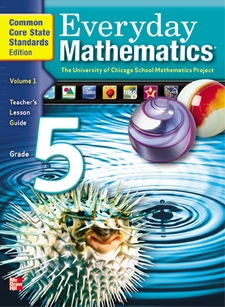
The Everyday Mathematics program, created by the University of Chicago, is a wonderful math program in my opinion.  I have now taught it for 14 years, and I can actually say that I finally feel like I have a clear understanding of how to teach each lesson in a way that my students will get the most out of our time spent together.

And to top it all off, each updated edition keeps getting better and better.  For example, the current edition is correlated to the common core standards.  Lessons were revised so that they could include the skills that the common core required.  Also, a new practice book was created so that students could have opportunities for extra practice if they need it.  I know that my students really benefit from the repeated independent practice!  Finally, there is an electronic component that allows teachers to project games and lessons on their whiteboards.  Students can be called up to the board to handle virtual manipulatives with our Mimio Teach device or solve problems by writing the answer with the stylus.

All of these changes have been extremely positive and have made a positive difference in our classrooms in regards to student achievement.  However, we as teachers have to make the call on how to spend our precious minutes with our students.  Despite how wonderful I think the new digital components are, I have discovered that my students benefit more from the traditional way of teaching, than they do from the new, more-engaging style.

Here is what my 60 minute math period looks like on a typical day (I will write how the step utilizes 21st Century skills in red):
Picture
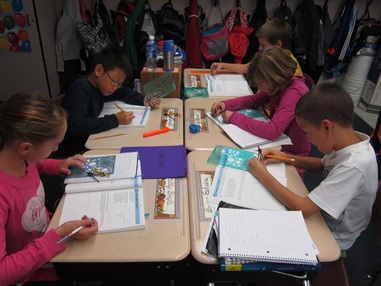
(1) Students enter the room, look at the directions on the TV, and start their independent work.  This is often a Math Box from the Everyday Math program.  They can ask their neighbors for help if they need to.  Those who are off-task or confused are politely re-directed by their peers and are offered help.  Math Boxes are review and preview problems, assuring that students don't forget skills they've been taught, and preparing them for skills they will need soon.  (Students make judgments and decisions independently, are self-directed, and are responsible for themselves and others.  Some students are working collaboratively and thinking interdependently.  Some are problem-solving, working creatively with others, and asking and answering questions.  Everyone is thinking critically and applying past knowledge to new situations in order to solve problems.  Because the teacher is not available to them, students must utilize their resources, persist despite setbacks, and try new ways to solve problems because they know that I will be checking these over tomorrow.  In order to finish before I'm done checking everyone in so they don't have extra homework, students are managing their time and setting mini-goals for themselves.)
Picture
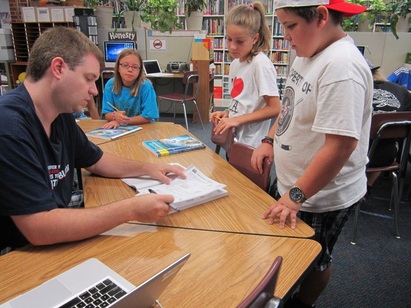
(2) While most are working, others are lining up to have their homework checked in.  This is my opportunity to give every child 30-45 seconds of 1-on-1 time during math.  I look over their homework, give them feedback and occasionally a brief re-teach, and give them a score.  If they are not finished with their work, I have them write it into their Assignment Notebooks to finish for homework.  (I am giving immediate, personal feedback to each student.  They are processing it, remembering what was taught in the past, and combining it with what I am re-teaching them.  This synthesis creates a stronger understanding, which is more permanent.  If they get a low score today, many are motivated to try harder tomorrow.  If they get a solid score today, the score extrinsically rewards them, but the extrinsic reward leads to sustained effort, not towards the need for praise or prizes.  Students who are not fully prepared for class are immediately given a consequence, asked to finish it after school, during lunch recess, or by tomorrow's class.  If they get too many missing assignments, I can make that decision for them immediately, before too much time passes.)
Picture
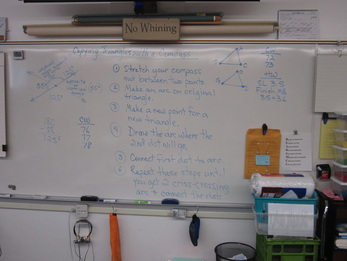
(3) When everyone has checked in, I move on to the Direct Instruction part of the lesson.  All of my students take out their spiral notebooks and we take notes!  We write the date at the top of the page, I give them a title (the name of the skill), and we practice together.  I use the gradual release of responsibility model here, where:
  • I do some sample problems for them and they watch.
  • Then, they help me complete some on the board.
  • Then, they do some in their notebooks while I walk around and assist.
  • Finally, they do one or two on their own and we check our answers.
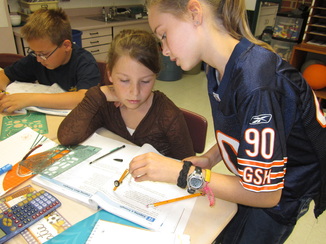
(Students learn through a visual and auditory pathway by listening and watching my lecture.  They also learn through a tactile pathway due to taking notes.  I determine the pace of the lesson (which is based on the readiness of the class), so students learn continuously with little downtime.  Students are asked to listen, learn, practice, and demonstrate their understanding in a psychologically-safe environment.  Confidence is built during this time as students start the lesson confused and unsure of themselves, but leave the lesson saying, "This is easy!")

Picture
(4) Next, we get into our Math Circles where we work on some practice problems from the book together as a table.  No one is allowed to go ahead, and everyone has to help everyone.  If their whole table finishes the classwork, they can show me and I will let them go on to their homework if their answers are correct.  (This is where the real collaboration and communication take place.  Students solve problems as a team, thinking interdependently and creatively with others at their table.  Students ask each other questions and learn how to answer them politely and clearly.  Students learn how to interact effectively with the diverse members of their team.  At some moments, everyone needs to become a leader and some moments they need to become a follower in order to get the task done.  Students learn to become responsible for themselves AND the others in their group.  If one member goes down, the whole team was not successful.  Even though the teacher is available during this time, students are required to ask "Three Before Me."  I will only help if the others at their table cannot.  This frees me up for the most pressing issues, which usually result in a quick, whole-class lesson.  This time is such an important moment in the period that I cringe when I don't have at least 15 minutes for it.)

(5) With a few minutes left in the period, I hand out their homework, ask them to write it down in their Assignment Notebooks, and we start to transition to our next subject.  (Students learn independent responsibility by writing their homework down themselves.  They learn to rely on a system that works for them for communicating to their "After-School Self."  By the end of the year (it takes the whole year for many of my kiddos), they have mastered a system that they will use for their middle school years.  Since students have to write down their homework, put their materials into their backpacks, and get ready for the next lesson, this is a chance to learn how to be a quick-thinking multi-tasker.)

So if you walked into my classroom during a math lesson, you might not realize how "21st Century" the hour really is!  I don't turn on the projector, we don't use our iPads or laptops, and students are taking notes while I lecture!  But now you know all of the 21st Century skills that my students are practicing.  When they leave fifth grade, they are very prepared for their world, and math class was a vital component of that preparation.  :)

13 Comments
Michael B.
10/11/2012 03:13:57 pm

Hi Mr. Solarz it's Michael. By the way, in math, will we learn more about ajacent angles before the test because there so so fun when we do them in class and they'are extreamly between hard-easy wich makes it different so it can be not so tough and tough wich makes it easy-hard. Also it's a great mixture of eqaitions of math.

Reply
Mr. Solarz link
10/11/2012 03:19:50 pm

Hey Michael! We can talk about that during our Review Day if you'd like - just mention it to me in class. I'd be so proud if you spoke up about it! :)

Reply
Althea Rodrigues
2/12/2013 06:36:39 pm

I am studying to be a teacher. Your Math class has so inspired me.
Thank you.

Reply
Paul Solarz
2/4/2014 01:51:53 pm

My pleasure Althea - thanks for the comment!!!

Reply
Rachel
5/15/2013 01:30:23 am

How do you use this time to differentiate? For example, what happens if a student has already mastered a skill? Do they have different work or do just do more of the same?

Reply
Paul Solarz
5/17/2013 12:37:03 pm

Thankfully, the Everyday Math program is such that a new skill is taught each day. No one has to spend too much time on something they understand perfectly!

Other ways that we differentiate for our higher math students include:
(1) We have one "Accelerated" math class that starts in 4th grade. They learn 4th grade math and some of 5th grade math. In 5th grade, they finish the 5th grade curriculum and do the entire 6th grade math curriculum.
(2) All of my students in my "Regular" math class have what I call CTAC (Choice Time Activity Center) packets. When they finish their independent work, they can work on these packets which provide extra practice and enrichment. Students choose which activities to work on and complete them in any order.
(3) Due to the collaborative nature of our class, students help each other throughout each lesson. Everyone has had opportunities to help others and opportunities to accept help from others. The confidence and aptitude of some students lead to better learning for all.
(4) I also attach a Pre-Test to the end of each Post-Test giving students the opportunity to demonstrate mastery of a skill if they choose to complete it. These students are allowed to "waiver" out of a lesson or lessons and instead work on critical thinking games, iPad apps, or other self-selected educational endeavors. They also do not have to complete the homework for that day.

Despite these differentiation techniques, most children prefer to participate in all lessons. They enjoy the routine, the reinforcement of skills, and the interaction with their peers and their teacher. I never hear anyone complaining that they are bored, I don't have discipline issues in class, and I feel that my students truly enjoy their hour spent learning math! Thanks for asking the question Rachel! I hope I answered it for you.

Reply
Heidi
10/31/2013 12:45:55 am

Hi Mr. Solarz,
Thanks for this post. I've been thinking a lot about my very traditional math lessons and concerned that I'm not doing what's best for students. Thanks for some ideas about how to crank up the collaboration and independence that students have.

Reply
Paul Solarz link
10/31/2013 02:37:54 am

So glad it helped Heidi - Thank you for reading!!!

Reply
Jennifer Roder link
2/3/2014 01:33:12 pm

I teach very low level math at the high school & I used to approach math this way. It really is effective for the masses. However many of my Ss fall into the at-risk category and learning is something different for everyone. I have gone to self paced learning( w/ due dates) and lots of different approaches to learning. Working with at risk kids has shaped the way I handle all my classes even my AP stats. Be open to doing something different if needed. See how it works, you might be amazed! To an awesome teacher from an awesome teacher:)

Reply
Paul Solarz
2/3/2014 02:26:59 pm

Thanks for the comment Jennifer! I am definitely always looking for ways to improve the quality of my instruction! Have you blogged about the way you do math? I'd love to read more about it & see how it may work in my elementary setting!!! Thanks again.

Reply
Paul Solarz
2/4/2014 01:55:04 pm

For anyone interested, here is Jennifer's blog post on this subject: http://mythoughtsonedu.blogspot.com/2014/02/how-math-class-works-for-me.html

Caz
2/3/2014 09:29:32 pm

Thanks... 21st Cen skills mean much more than technology. You capture the skills perfectly!

Reply
Paul Solarz
2/4/2014 01:44:47 pm

Thanks Caz!

Reply


Leave a Reply.

    Picture
    Picture

    My ePortfolio

    I am Paul Solarz, a 5th grade teacher in Arlington Heights, Illinois who is loving 21st Century Education. Please become part of my PLN on Twitter: @PaulSolarz

    Follow @PaulSolarz
    Tweet

    Archives

    April 2014
    February 2014
    January 2014
    December 2013
    November 2013
    October 2013
    September 2013
    August 2013
    May 2013
    April 2013
    February 2013
    January 2013
    December 2012
    October 2012
    September 2012
    August 2012
    May 2012

    Categories

    All

    RSS Feed

    Tweets by @PaulSolarz
Powered by Create your own unique website with customizable templates.